
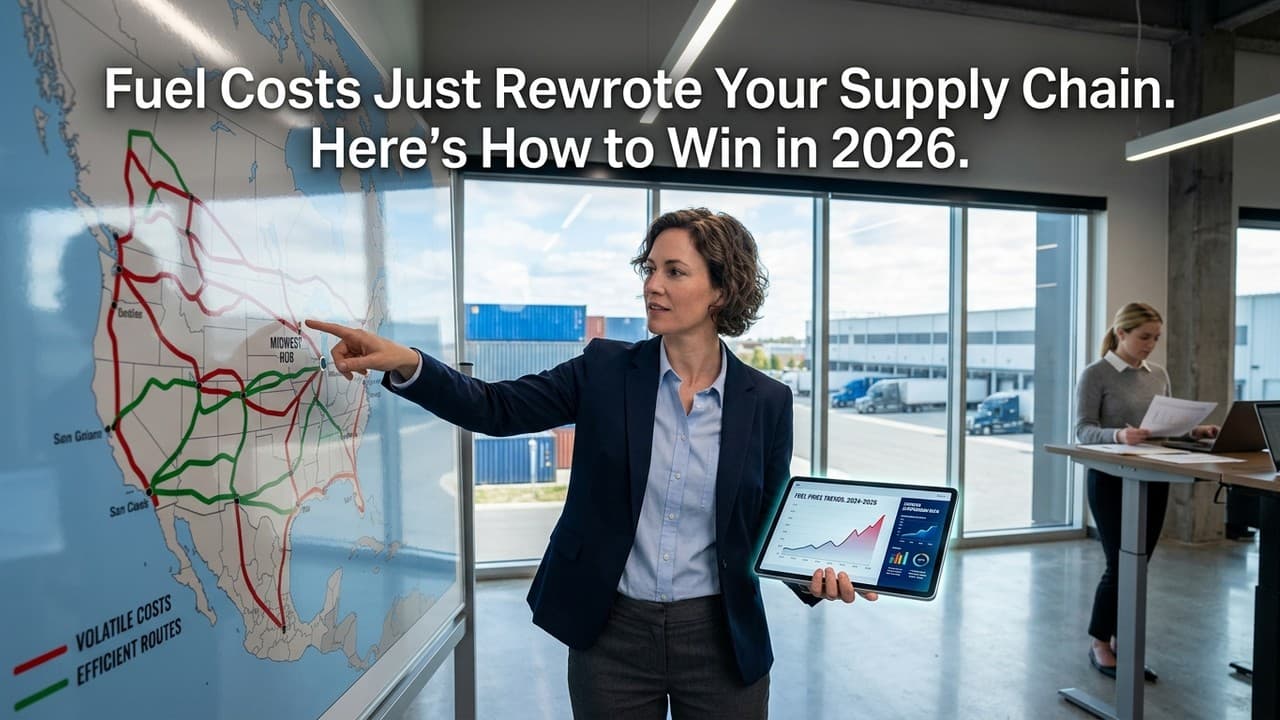
The Real Cost of Ignoring Fuel Volatility: Why Rate Shopping Misses the Point
Here's the hard truth most shippers don't want to hear: negotiating better fuel surcharges won't save your supply chain in 2026. While you're focused on squeezing another penny per mile from carriers, your competitors are completely redesigning their logistics networks around fuel efficiency and regional optimization.
The conventional wisdom says fuel costs are a cyclical problem that rate shopping can solve. That's reactive thinking that misses the bigger picture. The real opportunity lies in proactive supply chain architecture that treats fuel volatility as a permanent feature of the logistics landscape, not a temporary inconvenience.
In 2026, three forces are converging to create a strategic inflection point: rising fuel costs that show no signs of stabilizing, customer expectations for faster delivery that continue to accelerate, and the urgent need for supply chain resilience after years of global disruption. Companies that recognize this convergence as an opportunity to fundamentally rethink their logistics strategy will capture competitive advantage. Those who keep playing the old rate negotiation game will find themselves increasingly disadvantaged.
The shippers winning in this environment aren't just managing costs differently. They're building entirely different supply chains that turn fuel efficiency into a strategic weapon rather than a cost center to minimize.
Regionalization and Near-Shoring: The 2026 Supply Chain Redesign
The most successful shippers in 2026 are abandoning single-source, long-distance supply chains in favor of multi-regional networks that dramatically reduce fuel dependency. This isn't just about moving production closer to customers. It's about creating flexible logistics architectures that can adapt to fuel price volatility without sacrificing service levels.
Gateway Logistics understands this shift intimately through our strategic positioning. Our St. Louis headquarters combined with Houston operations creates natural regional optimization opportunities that many shippers overlook. This geographic diversity enables us to route shipments through the most fuel-efficient pathways while maintaining speed and reliability. When fuel costs spike in one corridor, we can pivot to alternative routing through our network without compromising delivery commitments.
The data supports this regional approach. Companies implementing near-shoring strategies report 15-30% reductions in total transportation costs, with fuel representing the largest component of those savings. The benefits extend beyond cost reduction. Regional supply chains offer faster response times to market changes, reduced inventory carrying costs, and greater resilience against disruption.
Smart shippers are also discovering that regionalization enables better carrier relationships. Instead of managing hundreds of long-haul routes with limited visibility, they're building deeper partnerships with regional carriers who understand local markets and can optimize fuel efficiency at the last mile. This creates a compounding effect where better carrier relationships lead to better fuel efficiency, which leads to better customer service.
The key is treating regionalization as a strategic capability, not just a cost-cutting exercise. The most effective shipper solutions in 2026 combine geographic optimization with advanced technology platforms that can dynamically route shipments based on real-time fuel costs and capacity availability.
Data-Driven Carrier Selection: The Technology Behind Smart Routing
The difference between reactive fuel management and proactive supply chain optimization comes down to data intelligence. Modern shipper solutions require technology platforms that can analyze carrier performance, fuel efficiency, and routing options in real time to identify the most cost-effective delivery pathways.
Gateway Logistics leverages our Veri5 System to provide this level of sophisticated analysis. The platform combines real-time market intelligence with historical performance data to identify carriers and routes that optimize both cost and service quality. This isn't just about finding the cheapest option. It's about finding the smartest option that balances fuel efficiency with reliability and speed.
Our extensive carrier network demonstrates the power of data-driven selection. Our association with M+R Forwarding (China) Ltd, representing 108,256 total shipment records, provides deep visibility into Pacific trade routes and fuel-efficient ocean freight options. Similarly, our partnership with InterFracht Container Overseas Service GmbH, with 17,779 total records and recent activity through May 2026, offers insights into European corridors that many shippers can't access independently.
This scale of data enables predictive routing decisions that anticipate fuel cost changes rather than react to them. When our system identifies potential fuel price increases on specific routes, it can automatically suggest alternative carriers or routing options that maintain service levels while controlling costs. The result is proactive fuel management that becomes a competitive advantage rather than a reactive cost burden.
The technology also enables transparency that builds trust with both shippers and carriers. Real-time visibility into routing decisions, fuel impact, and performance metrics creates accountability that drives continuous improvement across the entire network. This transparency transforms fuel management from a necessary evil into a strategic partnership tool.
From Transactional to Strategic: Building Growth Partnerships, Not Just Vendor Relationships
The most significant shift in 2026 logistics isn't technological or geographic. It's relational. Successful shippers are moving beyond transactional carrier relationships toward strategic partnerships that align fuel efficiency with business growth objectives.
This partnership approach addresses both rising fuel costs and accelerating delivery expectations simultaneously. Instead of viewing these as competing priorities, strategic 3PL relationships create solutions that improve both cost efficiency and service quality. Performance-based benchmarking ensures that fuel efficiency improvements don't come at the expense of delivery speed or reliability.
Gateway Logistics exemplifies this partnership approach through our multi-industry expertise and specialized cargo capabilities. Our permits to manage specialized cargo types, including waste materials, demonstrate the depth of operational knowledge that enables true partnership rather than simple vendor relationships. This expertise allows us to optimize fuel efficiency across diverse cargo types and regulatory requirements that many logistics providers can't handle.
On-site management and shared warehouse solutions represent another dimension of strategic partnership. By integrating directly with shipper operations, 3PL providers can identify fuel efficiency opportunities that aren't visible from arm's length vendor relationships. Shared warehouse solutions reduce the number of touches and transfers that waste fuel while improving inventory velocity.
The partnership model also enables innovation that benefits both parties. When 3PL providers have skin in the game through performance-based contracts, they're incentivized to develop new shipper solutions that improve fuel efficiency while growing business volume. This creates a virtuous cycle where better fuel management enables business growth, which justifies further investment in efficiency improvements.
Your 2026 Action Plan: Three Strategic Moves to Implement Now
The window for proactive supply chain redesign is closing rapidly. Shippers who wait for fuel costs to stabilize will find themselves permanently disadvantaged by competitors who act now. Here are three concrete steps to implement immediately.
First, conduct a comprehensive audit of your current supply chain architecture with regionalization as the primary lens. Use data-driven analysis to identify opportunities for near-shoring, regional sourcing, and multi-hub distribution strategies. This evaluation should focus on creating flexible networks that can adapt to fuel price volatility while maintaining service levels. The Veri5 System provides the analytical framework to evaluate these opportunities objectively rather than relying on assumptions about cost and service trade-offs.
Second, evaluate your carrier partnerships through the lens of total cost of ownership rather than simple rate comparison. Fuel efficiency, delivery reliability, and service quality create compounding value that often outweighs marginal rate differences. Look for carriers and 3PL providers who can demonstrate measurable fuel efficiency improvements through technology platforms and operational expertise. The goal is identifying partners who view fuel efficiency as a competitive advantage rather than a cost to minimize.
Third, implement transparent, real-time visibility into shipment routing and fuel impact across your entire logistics network. This visibility enables proactive decision-making that anticipates fuel cost changes rather than reacting to them. More importantly, it creates accountability that drives continuous improvement in fuel efficiency without sacrificing service quality.
The shippers who implement these three strategies now will lock in competitive advantages that compound over time. As fuel volatility continues through 2026 and beyond, the gap between proactive and reactive supply chain strategies will only widen. The time for incremental rate negotiation is over. The time for fundamental supply chain redesign is now.
Contact Gateway Logistics to discover how our Veri5 System and strategic partnership approach can transform your fuel challenges into competitive advantages, one shipment at a time.